

Ahead of Alvin Ailey American Dance Theater’s performances of Alonzo King’s Following the Subtle Current Upstream, we spoke with Clifton Brown, Assistant Rehearsal Director for the Ailey company. As an original cast member of the ballet, Clifton performed numerous roles since its premiere in 2001. He then brought that first-hand experience into rehearsals with the current Ailey dancers.
Backstage at New York City Center, Clifton shared the challenges of reviving Following the Subtle Current Upstream after nearly two decades, along with the insights he gained from Alonzo’s leadership. Read on (and watch) to learn Clifton’s practical tips towards spontaneity, along with his views on success, risk-taking, and the relevance of Alonzo’s work today.
Ailey performs Alonzo King’s Following the Subtle Current Upstream for select dates between December 14–30 at New York City Center. For tickets, visit our event page.
Interview by Erin McKay | Videos edited by Jamie Lyons
You were an original cast member for Following the Subtle Current Upstream. What are your memories from working with Alonzo King for those initial rehearsals?
Alonzo talked to us about approaching movement, including what steps mean and how much value they can have. I worked with him twice as a dancer, and many of the things he said carried great weight with me. Alonzo told us, “They made the book off of you. You’re not replicating something; the form exists because of what you created.” As a dancer, that hit me. I was young, and it was only my second year with the Ailey company. At twenty years old, I was still finding my way as a professional dancer, and Alonzo made me look at my role in a new way.
So often as artists, we’re replicating. When we’re not improvising, we often want to make our movements look exactly like the choreographer’s, without necessarily knowing why that’s good or why there’s value in that. After Alonzo’s insight, I could see the creation process from the reverse perspective: as a dancer, I wasn’t taking from a book; instead, my ideas had so much value that I could write them within the steps that the choreographer created.
Alonzo also told us, “Do what you think the movement is.” That was a challenge. While we were not asked to create the choreography ourselves, Alonzo did ask us to put ourselves into the movement.
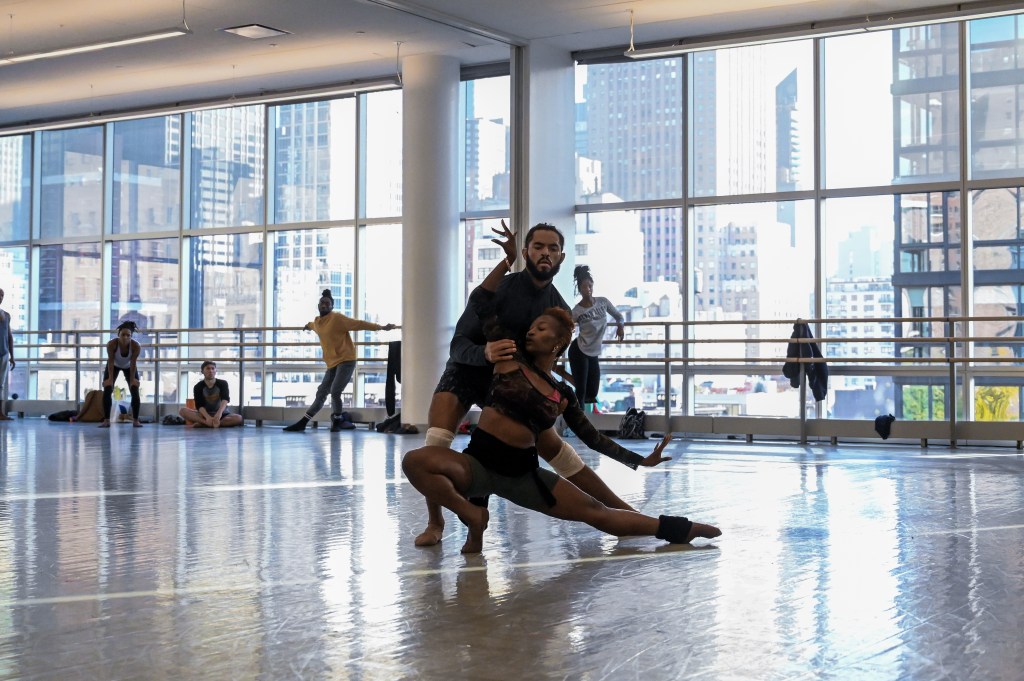
Photography: Alvin Ailey American Dance Theater | Dancers: James Gilmer and Coral Dolphin rehearsing Alonzo King’s Following the Subtle Current Upstream | © Grace Kathryn Landefeld
Did Alonzo’s view of dance impact your own?
What skills did Alonzo help you hone as a dancer?
As a dancer in a company like Ailey, you work with a lot of different choreographers and styles of movement, so you have to hone your ability to know what’s appropriate when. In some pieces, there is a more strict structure. You can still be an individual within those works, but if you change certain components, it’s no longer the piece. So, I learned to ask myself these questions:
- What world am I working in?
- What is being asked of me?
- And what am I able to offer?
Alonzo’s world didn’t have the strictest structure. He wouldn’t always give us a prescribed port de bras (1), which is a sequence of arm movements. Instead, he told us to use our arms in a way that made sense. That forced me to figure out what my intention was with the movement. I asked myself, “Do these arms serve what the rest of me is doing?” There were lots of acceptable options, but I determined that certain choices didn’t make sense within the whole. In this way, Alonzo helped me hone my judgment and intent.
I also cultivated trust while working with Alonzo; I had to trust myself enough to go for something without being told what it was or that it was okay.

Photography: Alvin Ailey American Dance Theater | Dancer: Coral Dolphin rehearsing Alonzo King’s Following the Subtle Current Upstream | © Grace Kathryn Landefeld
In your role as assistant rehearsal director for Ailey, what insights did you share with the dancers as they rehearsed the piece?
I think it’s really difficult to work backwards. I did Following the Subtle Current Upstream for over three years, so I had many opportunities to play with the movement and figure out what felt possible within it. But a revival process differs from the initial creation. The original cast of dancers are embedded into the movement of Following the Subtle Current Upstream. So now, the challenge is to put pieces of the current Ailey dancers into Alonzo’s work. Following the Subtle Current Upstream needs to be theirs now; they have to own it. To do that, I start with familiarizing the dancers with the shell. We figure out the steps and the feelings first, and then from there, we decide how to fill it in.
I think there is a need for spontaneity within Alonzo’s work as well. Even though it’s choreographed, some elements are left up to chance. For example, you don’t know exactly how you’re going to fall out of a balance. Sometimes you may sustain it more, and if you stay longer, you have to decide how you are going to make up that time in the music. Your suspension could create more urgency in what comes next. That is a natural flow that you have to follow.
In Alonzo’s work, you’re most successful when you’re in the moment and aware versus fretting that you need to do a specific step at a specific time. I try to help the dancers move away from creating strict plans and sticking to them. Those are the layers we excavated through in reviving his work.
How do you coach someone to become more comfortable with making spontaneous choices?
You speak about shedding self-consciousness and letting go of perfectionism through a habit of risk-taking. I think we avoid risk partially because of the consequences that come with failure. But what is failure?
Your question reminded me of this saying: “What is success but a stockpile of all your failures.” Each time we do something wrong, there is an opportunity to learn for the next time. If you’re always making safe choices that are within your control, you never take risks. You never find out anything new, and you never expand your sphere of experience or abilities.
Within Following the Subtle Current Upstream specifically, dancers have 25 minutes to try things out. If they take a risk and it doesn’t work, they still have more opportunities. Each risk results in a gain. Risk is worth it.
What have you learned from Alonzo’s leadership?
Alonzo said that Following the Subtle Current Upstream is a piece about how to return to joy. Why do you think this work is still relevant to today?
Alonzo’s work is applicable today for obvious reasons based on the state of the world. But I think Following the Subtle Current Upstream will always have relevance. There’s always an aspiration. There’s always a want for the better. Some people lose their way, or that desire gets overshadowed, but I believe that it’s in everyone. Everybody wants to return to joy, to something worth real celebration.
I love the moments of cacophony, for lack of a better word, that the audience will see in the finale of Following the Subtle Current Upstream. There’s so much fervor and kinetic energy, that you don’t know where to look. The dancers aren’t doing the same thing; everybody’s having their own experience. I don’t know…I feel like Following the Subtle Current Upstream speaks in a way that I can’t put well into words, but that’s why dance exists. That’s why dance is beautiful, and can’t be any other art form.
What do you see now that you didn’t see while you were dancing the piece?
I’ve been around for a fair amount of years now. Today, I’m noting how movement on its own speaks differently to different people, and I’m learning how to help a dancer get the most out of what they have to offer. My main advice to artists is this: bring all the juice out of a moment. Don’t leave anything in it.
As we talk, I’m thinking of a sequence of steps in Alonzo’s work that always said a whole lot to me: rond de jambe (2), sous-sus (3), soutenu (4) into développé (5). It’s like a spiral into an explosion. It may not be that for everyone, and that’s ok. But then I want them to show me something new within those steps. Show me something that I didn’t think of, because there’s so much value in sharing discovery. I want to see everything that the current dancers have to offer. I tell them, “Don’t keep anything away for yourself.”

Photography: Alvin Ailey American Dance Theater | Ailey dancers rehearsing Alonzo King’s Following the Subtle Current Upstream | © Grace Kathryn Landefeld
What can audiences expect from Following the Subtle Current Upstream?
Alonzo’s work is so universal and has such potential because of its honesty. He wants dancers to give of themselves, take risks, and share their vulnerability. I think we’re used to being theatrically vulnerable, but Following the Subtle Current Upstream doesn’t need that. The sentimentality of Alonzo’s work is in its honesty. I’m learning just how many ways I can help people get to that place of honesty and the power that comes with it.
The work is not about being pretty. Instead, there’s beauty, sensitivity, and strength in it. Our job as dancers is to ask “How many ways can we exhibit those qualities, and where can we find them?”
Footnotes
(1) Port de bras: the technique and practice of arm movement (sourced from Merriam-Webster)
(2) Rond de jambe: “…a classical ballet term meaning ’round of the leg.’ It is a very common step used in various forms throughout ballet class and performances, in which one leg moves in a straight line away from the body before executing a semi-circular motion. It can be performed either on the floor (à terre) or with the leg in the air (en l’air).” (sourced from Ballet Beautiful)
(3) Sous-sus: “…a classical ballet term that translates to ‘over-under’…It is a highly versatile step in which a dancer springs onto relevé demi-pointe or pointe, placing the back foot more closely behind the front in fifth position with fully stretched legs…” (sourced from Ballet Beautiful)
(4) Soutenu: a turn step that translates to “supported” or “sustained” in French. “The basis for this step is a crossed fifth position [a position in ballet where ‘the feet are turned out and pressed closely together, the heel of the one foot against the toe of the other’ —Britannica] on pointe/demi pointe [‘the position of the feet where the dancer has their full body weight on the balls of the feet’ —Ballet Manila Archives]. To learn more, visit our quoted source: DeCruz Ballet.
(5) Développé: a smooth, gradual unfolding of the leg in ballet (sourced from Britannica)
Photography: Alvin Ailey American Dance Theater | Dancer: Clifton Brown in Alonzo King’s Following the Subtle Current Upstream | © Nan Melville
Ailey Performs Alonzo’s Work
See Alvin Ailey American Dance Theater performing Alonzo King’s piece Following the Subtle Current Upstream for select dates between December 14–30 at New York City Center. This work mirrors life’s boisterous waves and reminds us that everything in nature seeks to return to its source. Alonzo’s movement—abstract but steeped in meaning—sets the Ailey dancers in a constant flow to eclectic scores by Zakir Hussain, Miguel Frasconi, and Miriam Makeba.
Photography: Alvin Ailey American Dance Theater | Dancer: Patrick Coker rehearsing Alonzo King’s Following the Subtle Current Upstream | © Grace Kathryn Landefeld

 LINESConnected